Tagadays 2026
- An event of ANR Tagada
- Dates. Mardi 31 mars, mercredi 1er avril, jeudi 2 avril 2026
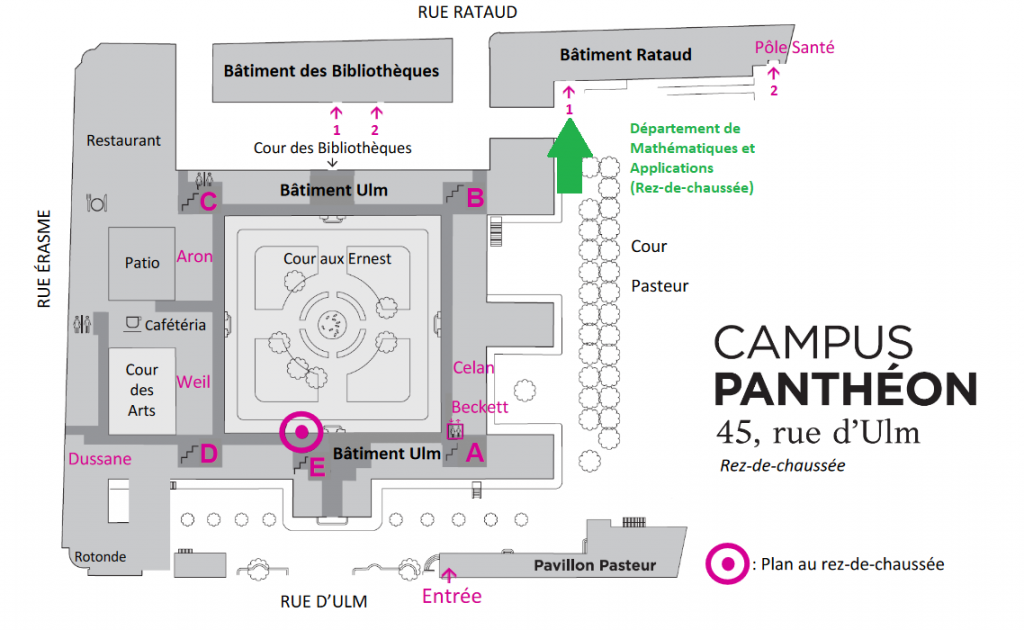
- Lieu. Salle W, Département de mathématiques et applications, École normale supérieure - PSL, 45 rue d'Ulm, Paris 5e
- Accès. Escalier B sur le plan : au dernier étage suivre la signalisation
- Programme (en évolution).
- Mardi 31 mars
- 09h30-10h30 : Jonathan Husson (Minicours A 1/3)
- 10h30-11h00 : Pause
- 11h00-12h00 : Luca Lionni (Minicours B 1/3)
- 12h00-14h00 : Pause déjeuner
- 14h00-14h30 : Stéphane Dartois (exposé court)
- 14h30-15h00 : Cécilia Lancien (exposé court)
- 15h00-16h00 : Pause
- 16h00-16h45 : Rémi Bonnin (exposé long)
- Mercredi 1er avril
- 09h30-10h30 : Jonathan Husson (Minicours A 2/3)
- 10h30-11h00 : Pause
- 11h00-12h00 : Luca Lionni (Minicours B 2/3)
- 14h00-14h30 : Xiaoyi Mai (exposé court)
- 14h30-15h00 : Kewei Pan (exposé court)
- 15h00-16h00 : Pause
- 16h00-16h45 : Alexis Imbert (exposé long)
- Jeudi 2 avril
- 09h30-10h30 : Jonathan Husson (Minicours A 3/3)
- 10h30-11h00 : Pause
- 11h00-12h00 : Luca Lionni (Minicours B 3/3)
- 14h00-14h30 : Guillaume Dubach (exposé court)
- 14h30-15h00 : Giulio Biroli (exposé court)
- 15h00-16h00 : Pause
- 16h00-16h45 : Racim Boudjema (exposé long)
- Titres et résumés.
- Minicours A : Jonathan Husson
Large deviations of the spectrum of random matrices and spherical integrals
In many applications of random matrices (in ecology, spin glasses or machine learning for instance), knowing when the extremal eigenvalues of such matrices are atypical is of paramount importance to understand the qualitative behavior of the system we model. We can reformulate this question using the framework of large deviations theory and ask for a given model : what are the large deviations of the spectrum? In this mini-course, we will remind some basics of random matrix theory and large deviation theory, review some now classical results about the large deviations of the spectrum for “classical” models (such as the GOE/GUE) and finally we introduce the spherical integral method which allows us to access the large deviations of the top eigenvalue of more general sub-Gaussian models. - Minicours B : Luca Lionni
Moments and free cumulants of unitarily invariant random tensors\\ In this minicourse, I will introduce the quantities that play the role of moments for invariant random tensors, relate this macroscopic description to the microscopic description in terms of joint moments of the tensor components, discuss the definition of the distribution in the limit of infinite size, introduce the first order moments for two examples (tensor products of random matrices and the complex Gaussian). I will then introduce the quantities that play the role of finite size precursors of the free cumulants of arbitrary order, and study their limits for the two examples above. Finally, I will discuss the moment formulation of tensorial freeness at first order, and then describe an algebraic construction of limiting spaces that generalizes non-commutative probability spaces in this context. Based on 2410.00908 and our two previous papers with Collins and Gurau, and some ongoing work with Buc d'Alché. - Exposé court 1 : Stéphane Dartois
- Exposé court 2 : Cécilia Lancien
Tensor product random matrix models and spectrum of random quantum channels - Exposé court 3 : Xiaoyi Mai
Open questions in spiked tensor moments and community detection on hypergraphs - Exposé court 4 : Kewei Pan
Boolean Entropy: A Microstates Point of View
I will begin by recalling some basic facts about Boolean independence, introduced by Speicher and Woroudi in 1991 as one of the universal notions of independence for algebras. In contrast to the free setting, where the central limit theorem leads to the semicircle law, the Boolean central limit theorem yields the Rademacher distribution as the limiting law. I will then discuss random matrix models that asymptotically exhibit Boolean independence. Using these models, one can derive a large deviation principle (LDP) with an explicit rate function. Motivated by Voiculescu’s definition of free entropy, we introduce a candidate notion of Boolean entropy. Finally, if time permits, I will present several Boolean analogues of classical results from information theory. - Exposé court 5 : Guillaume Dubach
Stabilité des valeurs propres et tenseur des overlaps généralisés - Exposé court 6 : Giulio Biroli
Diffusion model for generative AI and random matrix theory
Diffusion models have emerged as the state of the art in generative artificial intelligence for images, videos, and audio. These models rely on reversing a stochastic diffusion process—typically an Ornstein–Uhlenbeck dynamics—to generate new data by integrating a backward Langevin equation starting from pure noise. Despite their empirical success, a rigorous theoretical understanding of diffusion models remains an active area of research.In this talk, I will discuss how tools from random matrix theory provide valuable insights into this problem. In particular, I will highlight how several fundamental questions in diffusion models naturally translate into tractable and interesting problems in random matrix theory. A key focus will be the memorization–generalization transition, and how it can be analyzed within this framework. - Exposé long 1 : Rémi Bonnin
The spectrum of the infinite regular hypertree and applications
Inspired by works of Friedman, we define a notion of spectrum for the infinite regular hypertree and we compute it. We derive a limiting measure and explain how it is related with the empirical distribution of eigenvalues (in the sense of Qi) for finite d-regular hypergarphs. We discuss some applications (Alon-Boppana bound, free CLT,…). - Exposé long 2 : Alexis Imbert
Wiring diagram probability space and measure of a tensor
The goal of this talk is to propose a generalization of trafics for tensors and of Von Jones' planar algebras for the permutation invariance instead of unitary invariance. I will present a family of natural operations on tensors that are permutation invariant linear maps : the wiring diagrams. A vector space which is endowed with a linear map for each of those wiring diagrams is called a wiring diagram algebra. A wiring diagram algebra endowed with a positive linear form is a wiring diagram probability space. It is a good framework to study the asymptotic distribution (in the sense of wiring diagrams) of a collection of permutation invariant random tensors of possibly different orders. I will then present a new notion of measure associated to a tensor by viewing a wiring diagram algebra as a $*$-algebra for which the multiplicaiton between two tensors is their tensor product. This measure is an unconnected version of Gurau's “measure”. - Exposé long 3 : Racim Boudjema