- FR
- EN

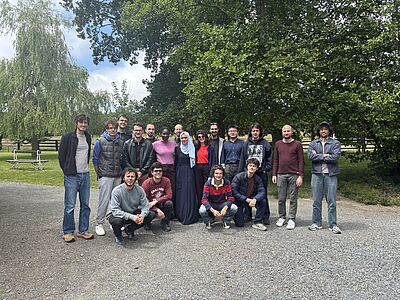
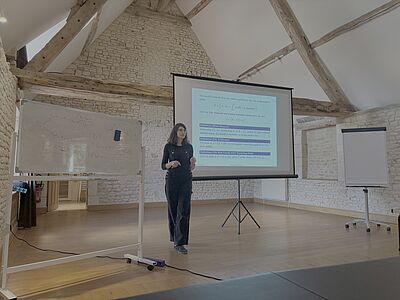
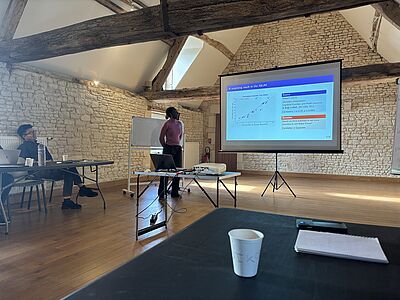
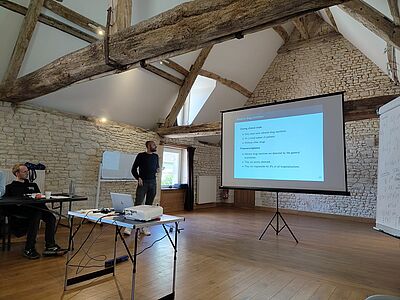
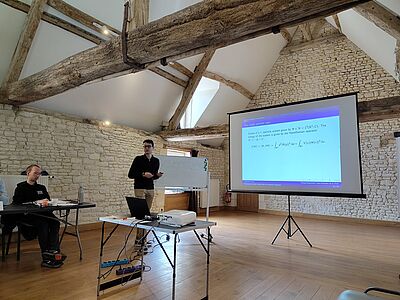
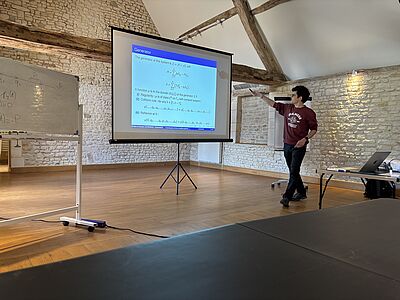
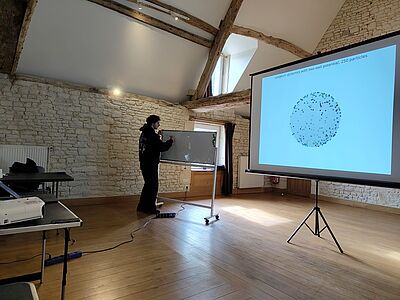
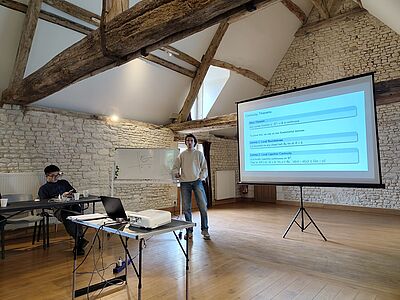
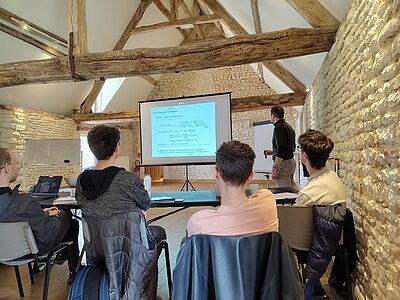
À l'occasion de l’édition 2026 des Young Researcher Days (YRD) — conférence organisée par et pour les doctorant·e·s du CEREMADE — les participant·e·s se sont retrouvé·e·s du 9 au 12 juin au Domaine de la Tour, au cœur de la campagne normande.
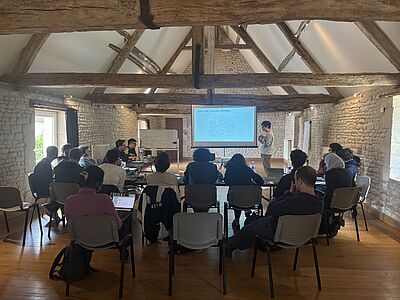
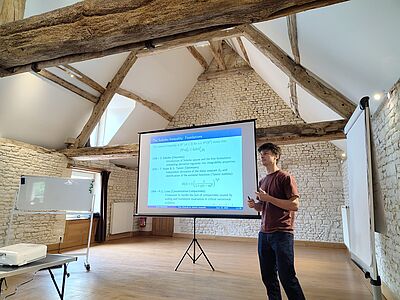
Cet événement annuel constitue un moment privilégié pour présenter l’état d’avancement de leurs travaux de thèse, mais aussi partager leurs perspectives et projets de recherche. Cette année, 18 doctorant·e·s ont pris part à la rencontre, donnant lieu à un programme riche composé d’autant d’exposés.
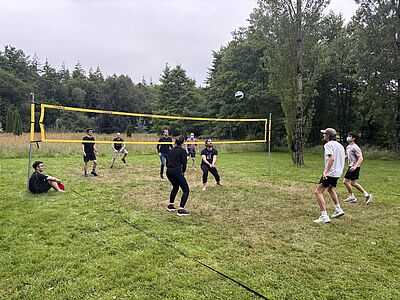
L’ambiance n’en est pas moins restée décontractée et festive : volleyball, jeux de société et autres activités ont rythmé les temps libres.
Organisateurs : Guillaume Soenen, Théo Leblanc, (Maël Duverger, Alexandre Surin)
Au programme de cette année :
Hydrodynamic limits of particle systems |
| The goal of this talk is to illustrate the hydrodynamic limit theory by examples. First, we study the Donsker’s theorem (about the convergence of the rescaled simple symmetric random walk on Z to the standard Brownian motion) with this point of view. Then, I will show the particle system on which I’m working: these particles are described by their position and their velocity. The hydrodynamic limit of this system should be the solution of a heat equation with free boundary: the space domain of the equation depends on the time. This free boundary is the main difficulty of this system: I will end the talk explaining how we manage to show the convergence, using relative entropy of the system.
|
Pricing and Hedging in Financial Markets |
How much should you pay today for a contract whose value depends on an uncertain future? This talk introduces the pricing problem in mathematical finance from scratch. Starting from a concrete hedging problem — an airline protecting itself against a spike in oil prices — we build up the key ideas: derivatives and options, self-financing replicating portfolios, and the principle of no arbitrage. We show how this single economic axiom forces the existence of a risk-neutral measure under which prices are simply discounted expectations, first in the one-period binomial model and then in continuous time via the Fundamental Theorems of Asset Pricing. We close with Girsanov's theorem and the Feynman–Kac link to PDEs, recovering the celebrated Black–Scholes formula.
|
|
Noncausal Time Series for Modelisation & Forecasting of Extreme Events |
| This presentation introduces mixed causal–noncausal autoregressive models for modelling and forecasting extreme events in financial and macroeconomic time series. Unlike standard causal autoregressive models, which mainly generate mean-reverting dynamics, noncausal and mixed processes can reproduce locally explosive trajectories followed by abrupt corrections, making them well suited to bubble-crash phenomena. These dynamics imply that, conditional on an extreme observation, future outcomes may be multimodal, with positive probability assigned both to continuation and collapse. This motivates a distributional forecasting approach based on a skewed Student-t Mixture Density Network, which estimates the full conditional predictive density while allowing for skewness, heavy tails, and multimodality. To improve tail performance, the presentation introduces a reweighting strategy based on generalized-boxplot tail detection and inverse-proportion weighting, combined with weighted sampling and a weighted likelihood objective. Since reweighting may affect probabilistic calibration, a post-hoc calibration step based on probability integral transform values is also discussed. Applications to natural gas prices, U.S. inflation, and crude oil prices illustrate the relevance of the approach for extreme-event forecasting. The presentation concludes by outlining future theoretical work on oracle inequalities, based on rewriting mixed causal–noncausal processes as nonlinear Markov chains with i.i.d. innovations. |
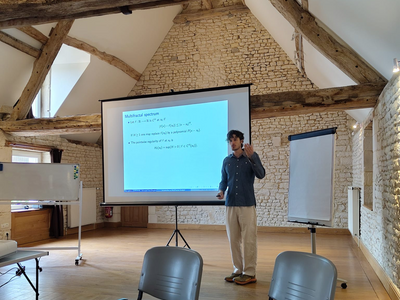
Introduction to Multifractal Analysis and application to Neuroscience |
|
This talk offers an introduction to multifractal analysis and its applications to signal modeling. We present the notions of pointwise regularity, Hausdorff dimension, and multifractal spectrum, together with the classical heuristic relating scaling exponents to the distribution of singularities. We then focus on wavelet and wavelet-leader methods, which provide efficient tools for the analysis of local regularity and multifractal behavior. We illustrate these ideas through classical cascades examples and discuss the multifractal formalism and the Frisch-Parisi conjecture. We conclude with motivations from neuroscience, where multifractal and wavelet-based approaches offer new perspectives for the study of brain activity signals.
|
|
In this presentation, I will motivate and present the non-convex low-dimensional relaxation of the orthogonal synchronization problem. As a non-convex optimization problem, it can have spurious local minima but we will explore conditions — on the Laplacian matrix of the problem and on the signal to noise ration of the model — under which all local minima are global minima.
|
|
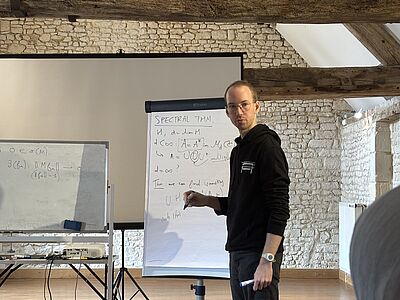
Introduction to the spectral theorem |
|
|
The quantum atomic model and the ionization conjecture |
Quantum mechanics aims to describe all kinds of phenomena that occur at the microscopic scale. In particular, one of the first and most remarkable result of this theory consists in providing an incredibly accurate description of atoms, molecules and their periodic features. Despite the simplicity of the physical systems considered, the mathematical background used to develop these models combines important theorems of Spectral Theory and Calculus of Variations. After a brief introduction to the mathematical formalism behind the quantum atomic model, we will see the so-called ionization conjecture, an open problem in mathematics linked to one most important periodic property of atoms.
|
|
Stability of the damped wave equation |
| In this talk I will survey the stability theory for the damped wave equation, focusing on the two extreme situations of strong stability and exponential (or uniform) stability. This problem is motivated by inverse problem (guessing the shape of a domain by measuring sound wave propagating along it) and sensor/room design (e.g. minimize/maximize the reverberation). The main part of the talk is to connect these two stability properties to controllability properties, which are themselves equivalent to observability properties of the free wave equation. Strong stability is seen as a rather weak property (any decent damping achieves it) while it is not evident at first glance how to impose exponential stability. The complete characterization of exponential stability by the geometric control condition will be sketched without proof, mainly with drawings.
|
Reconstruction of patient medical history from medico-administrative databases |
Randomized clinical trials remain the gold standard for evaluating drug effects, but they are costly, not always feasible, and often poorly suited to studying long-term outcomes in large populations. Real-world data can help address these limitations, while raising important methodological challenges related to bias, confounding, and causal interpretation.
|
|
From Correlation to the Interventional Density |
| Classical causal inference largely targets the average treatment effect (ATE), a single scalar summary of how an intervention shifts an outcome's mean. Yet two treatment arms can share an identical ATE while differing dramatically in variance, modality, or tail behavior: differences that carry real consequences for risk and heterogeneity but are invisible to the mean alone. This talk argues for shifting the object of interest from the ATE to the full interventional density of the outcome, identified through the backdoor formula under standard unconfoundedness assumptions. We then show that the natural plug-in estimator of this density inherits a first-order bias whenever flexible machine learning models are used for the conditional density, and we derive a one-step, influence-function-based correction that restores root-n efficiency and double robustness, extending the classical AIPW construction from means to entire densities.
|
Empirical processes and Chaining |
We will present the problem of proving Donsker-type theorem for an empirical process indexed by a class of functions. For this, we will present chaining, a technique developed to control the supremum of a stochastic process, and show how it can be used to prove Donsker type theorems. This talk is based on the books « Weak Convergence and Empirical Processes » by van der Vaart and Wellner and « The Generic Chaining » by Talagrand.
|
|
Statistical mechanics on isoradial graphs & Z-invariance |
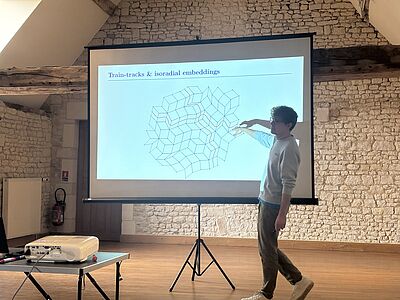
| In this talk, after giving some generalities on static 2D statistical mechanics (e.g. what models do we consider and what kind of questions we aim to answer), I will explain what are isoradial graphs and why they are a good framework for statistical mechanics. They are special planar graphs which we can draw on the plane in such a way that all faces are inscribed in circles of common radius, and the circumcenters of the circles lie in the interior of the faces. This allows to give some structure to the parameters of the statistical mechanics model we are considering. On isoradial graphs it is also natural to define what is Z-invariance, it's an invariance condition for the partition function under the so called star-triangle transformation. If it is satisfied it implies that the Boltzmann measure depends on the geometry of the graph only locally, and therefore the probabilities of interests should admit an explicit local formula. In the last section of the talk I will explain how the solution for the Z-invariant Ising model look like (the weights are expressed in terms of Jacobi elliptic functions). |
Regularity of Convex Functions on R^d |
In this talk, we explore the interplay between the geometry (convexity) and the regularity (continuity, differentiability) of real-valued functions defined on R^d. First, we review the standard properties of convex functions on R^d: continuity, as well as first- and second-order differentiability almost everywhere. Finally, we prove our recent improvement of a lemma that quantifies the Lipschitz continuity (in an averaged sense) of the gradient of a convex function.
|
|
Flow methods for functional inequalities |
| We prove the Sobolev inequality and characterize its optimizers using the carré du champ method on a fast diffusion flow. This flow allows us to bypass the standard concentration-compactness argument for the global-to-local reduction in the stability of the Sobolev inequality. |
Long-time behavior of optimal particle systems in mean-field control |
| We provide quantitative estimates on the long-time behavior of the optimal particle system associated with a mean-field control problem, allowing for time-changing cost functions and non-quadratic Hamiltonian. Our analysis covers both displacement and flat convex settings and extends to flat semi-convex regimes in which the concave part is absorbed by heat dissipation. Combining the modulated free energy method with functional inequalities on N-particle configurations, we compare arbitrary particle flows to their mean-field counterpart, obtaining a uniform-in-time propagation of chaos, as well as a turnpike estimate around the mean-field ergodic state up to an approximation error. |
|
Common Noise in Interacting Particle Systems: Examples and Open Questions |
| Interacting particle systems in out-of-equilibrium statistical physics are often driven by independent noise, representing microscopic fluctuations at the level of each particle. The role of such noise is by now relatively well understood. In contrast, several models arising from machine learning involve common noise: the particles are driven by shared random fluctuations rather than independent ones. This change of noise structure leads to new phenomena and raises questions that are still poorly understood. In this talk, I will discuss examples, observations, and open problems that I have encountered while studying such models. |
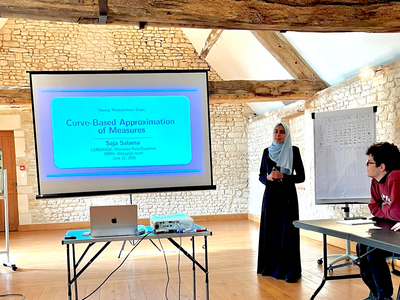
Curve-Based Approximation of Measures: Local Optimality Conditions |
Probability measures can be approximated by measures supported on curves. The motivation is to replace point-based approximations by continuous trajectories, especially in applications where the approximating object must follow a path. The mathematical framework is introduced through curve-supported measure classes and a kernel-based discrepancy used to compare a target measure with its approximation. The analysis highlights theoretical rates describing how the discrepancy decreases as the allowed curve length increases, together with numerical evidence on manifolds. The final part develops local optimality conditions for atomic, discrete, and continuous curve-supported approximations, leading to a curvature condition for normalized arc-length measures and revealing a connection between approximation, optimization, and geometric regularity. |
|
The Hartree-Fock Model |
| We give a mathematical introduction to the Hartree-Fock approximation in quantum mechanics. Starting from the N-body Schrödinger Hamiltonian, whose ground-state energy is a linear eigenvalue problem in an intractably large space, we explain how restricting the minimisation to Slater determinants — equivalently, to rank-N orthogonal projectors — yields a computable upper bound. The resulting energy functional is genuinely nonlinear, and its Euler-Lagrange equations take the form of a nonlinear eigenvalue problem governed by the Fock operator, combining a local direct term and a non-local exchange term. We discuss the self-consistent field iteration used to solve it, and, in the Coulomb case, the convexification of the problem and the existence of minimisers. |
 | |
 |  |


